
The rapid expansion of 5G wireless networks, driven by the increasing demand for bandwidth and low latency, has transformed the telecommunications landscape. 5G now delivers broadband connectivity to households in addition to its typical mobile applications, making it a viable alternative to wired broadband solutions.

Understanding 5G
5G, the latest wireless technology, represents a significant advancement in speed, latency reduction, and flexibility. It introduces a paradigm shift in communication, transforming how data is transmitted and received. With improved reliability and a consistent user experience, 5G enables an array of new applications and use cases, extending beyond network computing to include distributed computing.
The Power of 400G
400G optics offers a fourfold improvement in data transmission speed compared to its predecessor, 100G. As digital applications continue to drive massive bandwidth demands, 400G enables network infrastructure providers to meet these challenges. It is already being deployed in mass production data centers and core networks, pushing the boundaries of network capabilities.
The Interplay Between 5G and 400G
Although 5G wireless technology promises faster speeds and lower latency, its practical implementation relies on a robust wired network. The connectivity between local wireless 5G radio transmitters and the global switched network requires a strong wired infrastructure. Additionally, the low-latency connections between devices, data centers, and the cloud necessitate effective edge computing and higher fiber densification. Here, 400G plays a crucial role in bridging these networking gaps and enabling efficient operations and capacity at the network edge.
Driving 400G Transformation in 5G Applications
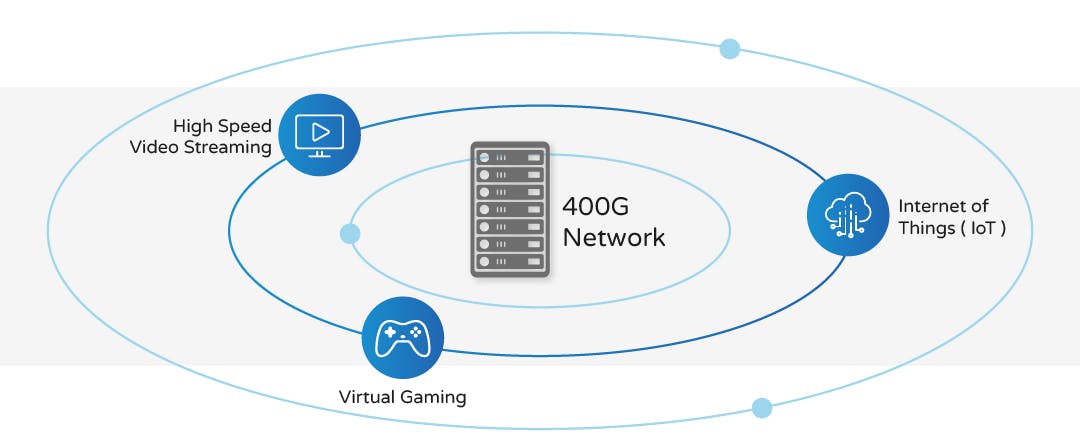
As demand for data-intensive services grows, businesses are realizing that investing in 5G and 400G technology is required to give the experiences they have come to expect from broadband connectivity. Below are some examples of how 400G is leading 5G in different applications.
1. Video Streaming
With the rapid deployment of 5G, the over-the-top viewing experience is set to reach new heights. Businesses offering digital streaming services will benefit from the increased connectivity and ultra-fast download speeds, eliminating video buffering. However, reliable power, efficiency, and density provided by 400G Ethernet are essential to support these applications.
2. Virtual Gaming
5G holds great promise for gamers, as it allows high-definition live streaming and eliminates the need for expensive devices with powerful computers. With 5G, mobile devices can display and handle high-definition games, while the processing, retrieval, and storage can be offloaded to the cloud.
3. Internet of Things (IoT)
The IoT has seen a widespread adoption across various industries, enabling applications that were once inconceivable. The combination of 5G and IoT provides low latency and ample network capacity to overcome key obstacles to IoT growth. However, meeting the enormous bandwidth demands while ensuring flexibility is crucial for the network infrastructure supporting these applications.
Conclusion
The convergence of 5G and 400G is shaping the future of connectivity and unlocking new possibilities across various applications. As 5G continues to expand, businesses must embrace the potential of 400G technology to support the increasing demands for bandwidth and ensure reliable, high-performance connectivity. By harnessing the power of 5G and leveraging the capabilities of 400G, businesses can stay at the forefront of technological advancements and deliver exceptional experiences to their customers in this era of rapid digital transformation.