
Across the globe, data center interconnects are currently under immense pressure due to the rise of Artificial Intelligence (AI) and other emerging technologies.
Within the USA, for example, there continues to be rapid expansion of AI data centers. This includes the Stargate project, a joint initiative by OpenAI, Oracle and SoftBank to grow and enhance AI data center infrastructure. Launched for the first time in January 2025, the project will see approximately $500 billion invested in order to create a 10-gigawatt capacity of AI computing power through the development of several data centers across the country. Initial sites are already under development in Texas, as these companies aim to establish US dominance in the field of AI.
We’re also seeing a similar picture emerge in the United Kingdom. The number of data centers within the country are set to increase by almost a fifth within the next five years, and landmark deals such as the UK-USA ‘Tech Prosperity Deal’ – announced in September 2025 – set to drive significant investment for the country’s AI and cloud computing infrastructure.
What Challenges Are Data Center Operators Facing?
It should come as no surprise that this unprecedented level of scalability is already causing significant issues for data center operators, especially those found in regions which have been earmarked to become tech hubs.
As more data centers are developed, greater and longer interconnections will be required. In order to achieve this, companies will need to heavily invest in additional repeater technologies, which can quickly become costly to procure and manage.
There are also cost concerns over energy too: AI data center power consumption is growing rapidly, and electricity demands for these facilities is projected to double by 2026 to around 1000 terawatt-hours (TWh) – roughly the current electricity consumption for the whole of Japan. With energy prices already in a volatile state, this is an extra headache for operators who are already facing large overheads over data center components.
Why Should Operators Use AddOn Networks' DCO Solutions?
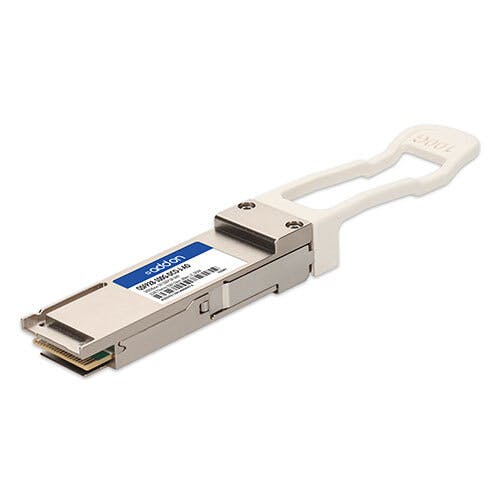
To overcome these issues, it’s essential that operators can utilize solutions capable of cutting overheads and simplifying network infrastructure, all without compromising on performance. For this reason, AddOn Networks has widened the 100G family to include 100G DCO DWDM offerings to support the next-generation of data centers.
Designed to complement our existing 400G ZR+ range, and reduce the number of active elements within the optical path, the DCO family can double the reach of existing Dense Wavelength Division Multiplexing (DWDM) infrastructure when compared to traditional offerings from other manufacturers.
Now you can push a DWDM link up to 80km from a QSFP28 port, the AddOn Networks DCO family is perfectly suited for companies and businesses focused on the interconnects between data centers and aggregated networks or high-bandwidth backhauls. AddOn currently offers these solutions in four variants, including a -10dB and a high-power 0 dB version, plus tunable and auto tune versions. A C-CMIS version is also planned to be made available to customers in Q1 2026.
What Other Benefits Does the DCO Family Enable?
Thanks to this extended network reach, operators are able to reduce the amount of Points of Prescence (PoP) and Reconfigurable Optical Add-Drop Multiplexers (ROADM) within their data center infrastructure. This helps them not only save on procurement and maintenance costs, alongside the power required to operate.
ITEMP/CTEMP versions of the DCO solutions are also available for specific customer requirements. With AddOn Networks, our service doesn’t just stop once the product is sold either – our round the clock support and availability of products means operators can rely on a near-immediate response once our transceivers are implemented within the network.